

Facebook | Develop Site


Canadian Start-up smartARM Uses AI to Create Intuitive Bionic Prosthetics
People and companies are using AI hardware and software to make life easier and more accessible for everyone. That’s the case with smartARM, a Toronto-based startup developing a vision-first bionic arm prototype that uses open-source software, with Meta AI glasses as an optional add-on, to explore more intuitive prosthetic control for people living with limb differences.
https://about.fb.com/wp-content/uploads/2026/09/META-4872_BTTxSmartARM_Long_youtube_16x9_1002_Subs.mp4Many traditional prosthetic hands require users to switch manually between grip patterns for different objects, making it cumbersome to move everyday items. Something as seemingly natural as picking up a glass, and then a spoon, becomes a multistep process. smartARM addressed this by developing AI hardware and software that understands the environment, and automatically selects a suitable grip for the object – so users can intuitively move between everyday tasks.
smartARM’s prosthetic arm “sees” through a camera embedded in its palm. The team is using DINOv2, Meta’s open-source vision model, to help it recognize everyday objects from just a few reference photos, supporting smartARM’s grip-selection software.This allows it to grip and pick up objects based on direct visual feature reading, without needing prior understanding or additional programming. The arm can adapt almost instantly to objects trained on just a few photos – something that could take weeks previously.
smartARM uses Meta AI Glasses and the Meta Wearables Device Access Toolkit to extend and improve object recognition and understanding, providing more data from the egocentric point of view the glasses offer. Meta AI glasses give the arm additional context to better understand what the user is trying to interact with. It also lets users add new objects, through the device app on their phones, giving everyone in the smartARM community a way to personalize their prosthetic around their everyday needs.
For the people who wear it, the results are life altering: a bionic arm that works from the first try, with no training required.
Long-time smartARM user and former NFL player Shaquem Griffin described what it feels like to use it: “Of all the tech packed into it, scalability and accessibility matter most to me. This is the future of consumer prosthetics.”
“Building a capable hand is only part of the challenge. Making it intuitive to use matters just as much,” said Hamayal Choudhry, smartARM’s Founder and CEO. “By helping the arm recognize everyday objects and select a suitable grip, we’re working toward an experience where people can focus more on what they want to do and less on how to operate their prosthetic.”
The post Canadian Start-up smartARM Uses AI to Create Intuitive Bionic Prosthetics appeared first on Meta Newsroom.
Threads Expands Podcast Toolkit for Creators and Listeners
We’re announcing new Threads tools for podcast creators and listeners, giving creators more ways to share their shows and listeners more ways to have conversations around the podcasts they love.
Here are some of the new features rolling out today:
- Show off your podcast: You can now display banners across your profile and posts, so listeners can more easily find your show.
- Share your best work: Feature your favorite episode with the episode picker, and make your podcast links appear as a tappable card.
- Broadcast the highlights: You can now share standout moments and featured guests with transcript, video, and guest card posts.
- Save your faves: You can now save episodes you come across in your feed, so never lose track of the content that’s catching your attention.
- Keep them coming back: You can opt in to getting an automatic notification from Threads reminding you to share new episodes with your audience
- Get to know your audience: Insights now show the reach and engagement Threads is driving for a podcast, including clicks and saves.
Threads is already a place where people are connecting around podcasts, and these updates make it even easier to join conversations about your favorite shows.
The post Threads Expands Podcast Toolkit for Creators and Listeners appeared first on Meta Newsroom.
Threads Introduces Parental Supervision for Teens in APAC
As part of our ongoing commitment to providing parents with helpful tools to support their teens across Meta’s apps, we’re bringing parental supervision to Threads. Starting this week in Asia Pacific countries, parents and guardians in Family Center will have visibility and controls on Threads, as they do across our other apps.
Teen Accounts on Threads have automatic, built-in protections like private accounts and limits on the content teens see. Beginning this week, parents can decide if teens under 16 can change any of these settings to be less strict, and will have access to new insights and controls.
How Supervision Works on ThreadsParental Supervision offers a set of tools and insights that parents and guardians can use to help support their teen on Threads. When supervision is set up, parents and guardians can:
- See time spent: View how much time their teen has spent on Threads each day for the past week, including their average daily time spent for the week.
- Set time limits: Set a daily time limit for how long their teen can use Threads and block access during select days and hours. If Threads is used on multiple devices, time limits apply to the total time spent using Threads.
- Adjust sleep mode: Parents can limit or block their teen’s access to Threads at night, with notifications muted and auto-replies on by default from 10 PM to 7 AM.
- Manage tagging: Control who can tag their teen in posts.
- Manage privacy and content preferences: Manage and approve some of their teen’s privacy settings and sensitive content preferences.
To set up supervision on Threads, visit familycenter.meta.com/supervision. We’ll continue expanding our supervision tools to make it easier for parents to find controls, get meaningful visibility, and support their teen’s experience across our apps — all in one place.
The post Threads Introduces Parental Supervision for Teens in APAC appeared first on Meta Newsroom.
Présentation de Meta One : Un service d’abonnement offrant davantage de fonctionnalités et d’IA pour créer, se connecter et se démarquer
- Nous lançons Meta One, un nouveau service d’abonnement sur nos applications qui offre un usage accru de l’IA et des fonctionnalités d’expression enrichies, ainsi que des outils professionnels pour les créateurs et les entreprises.
- Les offres Meta One sont déployées progressivement, avec plus de 50 fonctionnalités lancées et 15 millions d’abonnements et d’essais à ce jour.
- L’expérience principale sur nos applications et Meta AI restera gratuite.
Aujourd’hui, nous lançons Meta One, un nouveau service d’abonnement qui apporte davantage de valeur aux applications et aux expériences que des milliards de personnes utilisent déjà, avec des offres destinées aux particuliers, aux créateurs et aux entreprises.
Meta One offre aux abonnés davantage de fonctionnalités d’expression et un usage accru de l’IA, aide les créateurs à consacrer plus de temps à la création et moins de temps à se demander ce qui fonctionne, et propose aux entreprises de nouveaux outils pour les aider à se développer. L’expérience principale sur nos applications et Meta AI a toujours été gratuite, et cela ne changera pas. Les abonnements donnent accès à des fonctionnalités plus spécialisées et à un usage étendu de l’IA, allant au-delà de ce qu’une expérience gratuite conçue pour des milliards de personnes peut offrir.
Nous lançons Meta One avec plus de 50 fonctionnalités sur Instagram, Facebook, WhatsApp et Meta AI, avant de l’étendre progressivement à Edits, aux lunettes IA et à d’autres produits.
Offres pour les particuliers et les utilisateurs avancés de l’IAPlus tôt cette année, nous avons lancé les offres Meta One pour un seul produit — Instagram Plus, Facebook Plus et WhatsApp Plus — qui proposent de nouvelles fonctionnalités exclusives permettant davantage de connexion et de créativité sur Instagram et Facebook, ainsi que davantage d’organisation et de personnalisation sur WhatsApp.
Ces offres affichent une forte rétention et nous continuons à les développer. Instagram Plus a récemment ajouté des polices personnalisées pour les messages privés (DM) et les Stories, des notifications lorsque certaines personnes regardent votre Story, ainsi que des aperçus des DM. Facebook Plus ajoute des options de personnalisation pour Messenger, propose davantage d’insights sur les Reels et étend les super réactions aux Reels et aux publications du Feed. WhatsApp Plus testera prochainement le stockage des sauvegardes des discussions et des médias, ainsi que les Focus Schedules, qui vous aident à préserver les moments qui comptent le plus en mettant en sourdine ou en masquant certaines discussions selon un calendrier défini.
Meta One va encore plus loin avec les offres groupées Core et Premium, qui combinent les fonctionnalités de nos offres pour un seul produit avec un usage accru de certaines de nos fonctionnalités d’IA nécessitant le plus de puissance de calcul.
Cela signifie davantage de génération de contenus multimedia avec Meta AI, notamment la création et la modification d’images et la génération de vidéos grâce aux modèles Muse, ainsi qu’un usage accru des outils d’IA intégrés aux applications, comme Restyle sur Instagram.
Meta AI restera gratuit pour les usages du quotidien. Core et Premium s’adressent aux personnes qui souhaitent bénéficier d’encore plus de liberté créative avec nos outils d’IA. Lors des premiers tests, plus de la moitié des abonnés ont utilisé à la fois les fonctionnalités d’IA et d’expression proposées dans nos offres groupées. Les fonctionnalités d’IA comme Restyle et les effets vocaux sur Instagram figurent parmi les principales raisons ayant motivé leur abonnement.
Offres pour les créateurs et les entreprisesDévelopper une audience et gérer une entreprise sur les réseaux sociaux demande un travail constant : créer du contenu, suivre ce qui trouve un écho auprès de son audience et se démarquer auprès de nouveaux publics. Les offres Meta One pour les créateurs et les entreprises intègrent davantage d’outils professionnels et d’IA directement dans les applications que votre audience et vos clients utilisent déjà. Vous pouvez ainsi gérer votre présence sans avoir à créer un nouveau compte ni à télécharger une nouvelle application.
Meta One propose de nouvelles fonctionnalités qui vous aident à établir votre présence et à transformer l’attention en action : un profil enrichi qui met en avant votre site web, vos différents établissements et ce que les utilisateurs disent de vous ; un bouton « Suivre » plus visible sur vos Reels ; ainsi que des invitations à vous suivre envoyées automatiquement aux personnes qui interagissent avec votre contenu. Vous pouvez également répondre à vos clients de jour comme de nuit grâce à un accès accru à Meta Business Agent.
Nous continuerons à ajouter des fonctionnalités et des capacités d’agents conçues pour aider les petites entreprises et les créateurs dans l’ensemble de leurs activités de marketing, de gestion, de création de contenu et d’optimisation.
Par exemple, nous intégrerons bientôt Edits Plus à Meta One, une nouvelle offre qui propose davantage de stockage dans le cloud afin de synchroniser vos projets et d’y accéder depuis différents appareils, ainsi qu’un usage accru du futur assistant Edits, qui vous aide à analyser vos insights Instagram et à trouver de nouvelles idées.
Comment commencerLes offres Meta One sont désormais disponibles dans le monde entier, à partir de 2,49 € par mois pour les offres sur un seul produit, 6,99 € par mois pour les offres groupées destinées aux particuliers et 16,99 € par mois pour les offres groupées destinées aux créateurs et aux entreprises.
Offres pour un seul produit- Instagram Plus (2,99 €/mois) : exprimez-vous, créez des liens plus étroits avec vos amis et personnalisez votre expérience de nouvelles façons.
- WhatsApp Plus (2,49 €/mois) : restez organisé et exprimez votre personnalité grâce à des thèmes et des icônes exclusifs, des stickers avec effets spéciaux et la possibilité d’épingler davantage de discussions.
- Facebook Plus (2,99 €/mois) : personnalisez Facebook à votre image et enrichissez votre expérience grâce à des fonctionnalités telles que des icônes d’application personnalisées, des super cœurs et bien plus encore.
- Core (6,99 €/mois) : utilisez davantage Restyle pour vos Stories sur Instagram, profitez plus souvent des effets vocaux et des outils créatifs, et générez davantage d’images et de vidéos avec Meta AI. Exprimez-vous également davantage de façons grâce aux fonctionnalités de nos offres individuelles (Instagram Plus, WhatsApp Plus et Facebook Plus).
- Premium (20,99 €/mois) : tout ce qui est inclus dans Core, avec les niveaux d’usage les plus élevés pour créer du contenu avec Meta AI et sur l’ensemble de notre famille d’applications.
- Essential (à partir de 16,99 €/mois) : établissez votre présence et renforcez la confiance auprès de nouveaux publics. Accédez à des outils pour gérer votre présence et bénéficiez d’un accès accru à Meta Business Agent sur WhatsApp afin de répondre à vos clients 24h/24 et 7j/7. L’offre comprend également un badge vérifié, un canal vérifié dans l’application WhatsApp Business et une protection contre l’usurpation d’identité, afin que les utilisateurs sachent que vous êtes bien la personne ou l’entreprise que vous affirmez être, sous réserve d’une vérification réussie.
- Advanced (à partir de 54,99 €/mois) : investissez dans des outils de niveau professionnel. Profitez de fonctionnalités de publication avancées, comme la programmation des Stories jusqu’à 30 jours à l’avance, l’ajout de liens dans les publications organiques et les Reels, des données analytiques exportables et des insights plus approfondis sur votre audience. Donnez aux membres de votre équipe accès à votre compte sans partager votre mot de passe et bénéficiez de davantage d’appareils associés et de crédits de diffusion pour les entreprises sur WhatsApp. Vous bénéficiez également d’un nombre encore plus important de réponses de Meta Business Agent.
- Expert (à partir de 169 €/mois) et Max (à partir de 549 €/mois) : passez à l’échelle et optimisez vos activités. Ces offres comprennent nos niveaux d’accès les plus élevés aux fonctionnalités et à la capacité de Meta Business Agent pour les équipes qui gèrent leurs activités à grande échelle.
Les offres, les avantages, les tarifs et la disponibilité peuvent varier selon les régions, les applications et les comptes. Pour connaître les fonctionnalités spécifiquement disponibles pour votre compte, commencez le processus d’abonnement.
The post Présentation de Meta One : Un service d’abonnement offrant davantage de fonctionnalités et d’IA pour créer, se connecter et se démarquer appeared first on Meta Newsroom.
Introducing Meta One: A Subscription Service With More Features and AI to Create, Connect, and Stand Out
Today, we’re introducing Meta One: a new subscription service that brings more value to the apps and experiences billions of people already use — with plans for individuals, creators, and businesses.
Meta One gives subscribers more self-expression features and AI usage, helps creators spend more time creating and less time guessing, and gives businesses new tools designed to help them grow. The core experience across our apps and Meta AI has always been free, and that’s not changing. Subscriptions unlock more specialized capabilities and expanded AI usage that go beyond what a free experience built for billions can offer.
We’re launching with more than 50 features on Instagram, Facebook, WhatsApp, and Meta AI, and will expand to Edits, AI glasses, and more over time.
Plans for Individuals and AI Power UsersEarlier this year, we launched Meta One single product plans — Instagram Plus, Facebook Plus, and WhatsApp Plus — offering exclusive new features that enable more connection and creativity on Instagram and Facebook and more organization and personalization on WhatsApp.
These plans are seeing strong retention and we’re continuing to grow them. Instagram Plus recently added custom DM and Story fonts, notifications when certain people view your Story, and DM previews. Facebook Plus is adding customization options for Messenger, offering more Reels insights, and expanding super reactions to Reels and Feed posts. WhatsApp Plus will soon test storage for chat and media backups and Focus Schedules, which help you protect the time that matters most by muting or hiding chats on a schedule.
Meta One goes even further with Core and Premium bundle plans, which combine the features from our single product plans with more usage of some of our most compute-intensive AI capabilities.
This means more media generation with Meta AI, including creating and editing images and generating videos powered by Muse models, and more use of in-app AI tools like Restyle on Instagram.
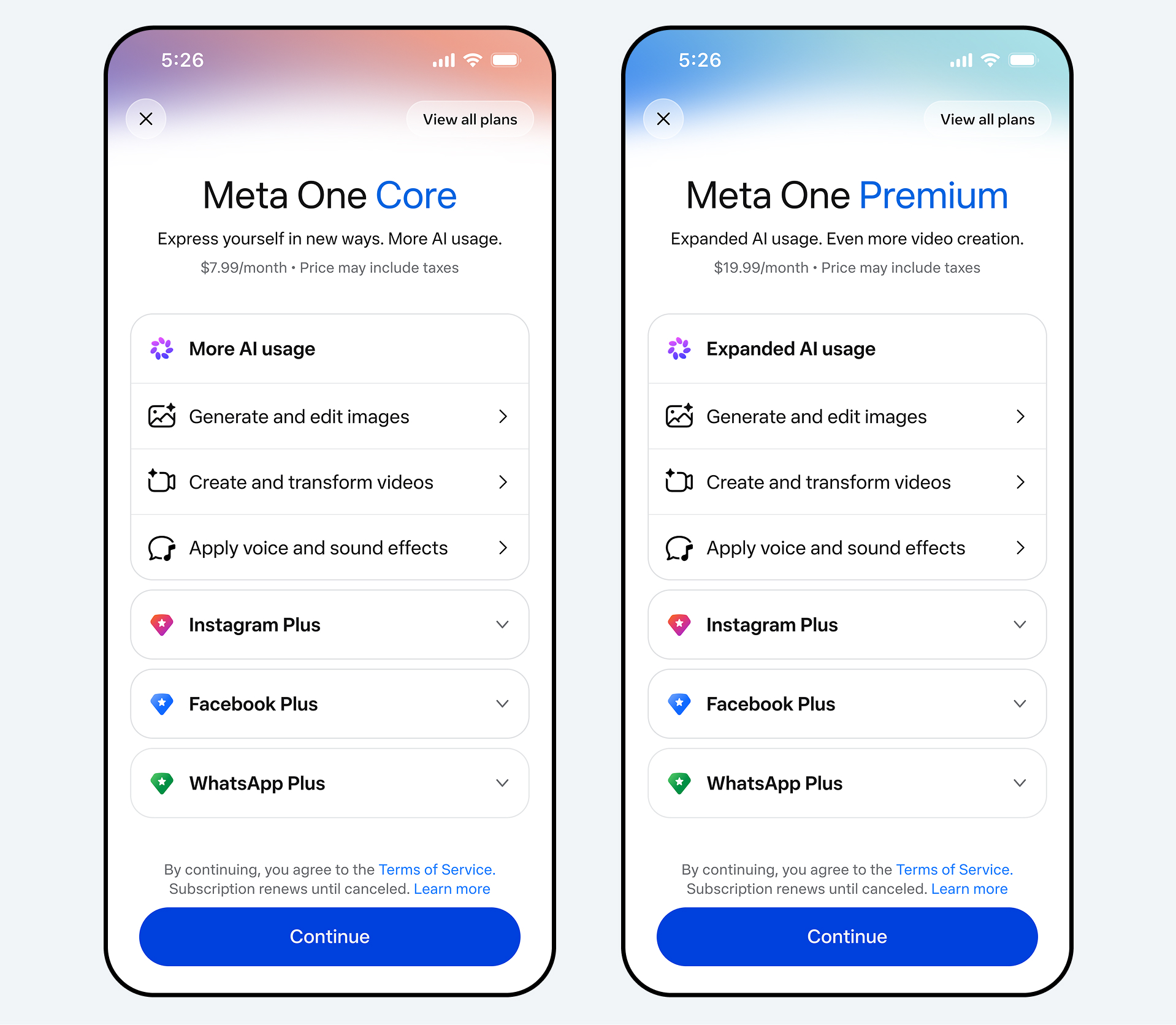
Meta AI will still be free for everyday use — Core and Premium are for people who want even more creative freedom from our AI tools. In early testing, more than half of subscribers engaged with both AI and expression features in our bundled plans, with AI features like Restyle and voice effects on Instagram among the top reasons people subscribed.
Plans for Creators and BusinessesGrowing an audience and running a business on social media takes constant work — from creating content and staying on top of what’s resonating to standing out with new audiences. Meta One creator and business plans put more professional tools and AI directly into the apps your audience and customers already use, so you can manage your presence without having to set up a new account or download a new app.
Meta One offers new features that help you establish your presence and turn attention into action: an enhanced profile that showcases your website, locations, and what people say about you; a bold follow button on your reels; and follow invitations sent automatically to people who engage with your content. Plus, respond to customers day and night with more access to Meta Business Agent.
We’ll continue to add features and agent skills built to help small businesses and creators with end-to-end marketing, business operations, content creation, and optimization. For example, soon we’ll bring Edits Plus to Meta One, a new product plan that offers more cloud storage so you can sync and access projects across devices, plus additional usage of the upcoming Edits assistant, which helps you analyze your Instagram insights and brainstorm new ideas.
How to Get StartedMeta One plans are now available globally and start at just $2.99 a month for single products, $7.99 a month for individual bundles, and $14.99 a month for creator and business bundles.
Single product plans
- Instagram Plus ($3.99/mo): Express yourself, connect more deeply with friends, and customize your experience in new ways.
- WhatsApp Plus ($2.99/mo): Stay organized and express your personality with exclusive themes and icons, special effect stickers, and the ability to pin more chats.
- Facebook Plus ($3.99/mo): Make Facebook yours and supercharge your experience with features like custom app icons, super hearts, and more.
Bundle plans for individuals and AI power users
- Core ($7.99/mo): Restyle more Stories on Instagram, use voice effects and creative tools more often, and generate more images and videos with Meta AI. Plus, express yourself in more ways with our individual app features (Instagram Plus, WhatsApp Plus, Facebook Plus).
- Premium ($19.99/mo): Everything in Core, with the most room to create content with Meta AI and across our family of apps.
Bundle plans for businesses and creators
- Essential (starting at $14.99/mo): Establish yourself and build confidence with new audiences. Get tools to manage your presence and more access to Meta Business Agent on WhatsApp to respond to customers 24/7. Plus, a verified badge, verified channel on WhatsApp Business app, and impersonation protection so people know you’re who you say you are (pending successful verification).
- Advanced (starting at $49.99/mo): Invest in professional-grade tools. Advanced publishing features like scheduling stories up to 30 days in advance, links in organic posts and reels, exportable analytics, and deeper audience insights. Give team members access to your account without sharing your password and get more linked devices and business broadcast credits on WhatsApp. Plus, even more Meta Business Agent responses.
- Expert (starting at $149/mo) and Max (starting at $499/mo): Scale and optimize. These plans include our highest levels of feature access and Meta Business Agent capacity for teams managing at scale.
Plans, benefits, pricing, and availability may vary by region, by app, and by account. To see the specific features available to your account, start the subscription process.
Learn more about Meta One by heading to the Meta One website.
The post Introducing Meta One: A Subscription Service With More Features and AI to Create, Connect, and Stand Out appeared first on Meta Newsroom.